
India’s landscapes—from Himalayan villages and mangrove forests to desert settlements and coastal communities—can face increasing pressure as tourism grows. Sustainable travel offers a practical way to explore these places while reducing waste, limiting avoidable environmental impacts, and supporting local businesses and communities through tourism. It does not require giving up comfort or avoiding popular destinations. Instead, it involves making more considered choices: travelling in smaller groups where practical, using public transport when suitable, choosing locally owned accommodation, carrying reusable essentials, respecting wildlife rules, and spending responsibly.
This guide explains how to plan lower-impact trips across India, from choosing destinations and transport to managing food, water, waste, and cultural interactions. It also examines common greenwashing claims and the difference between genuinely responsible tourism practices and vague marketing language. If you are planning a trip, the aim is simple: to travel in a way that reduces avoidable impacts, respects local communities and cultures, and helps protect the places you visit.
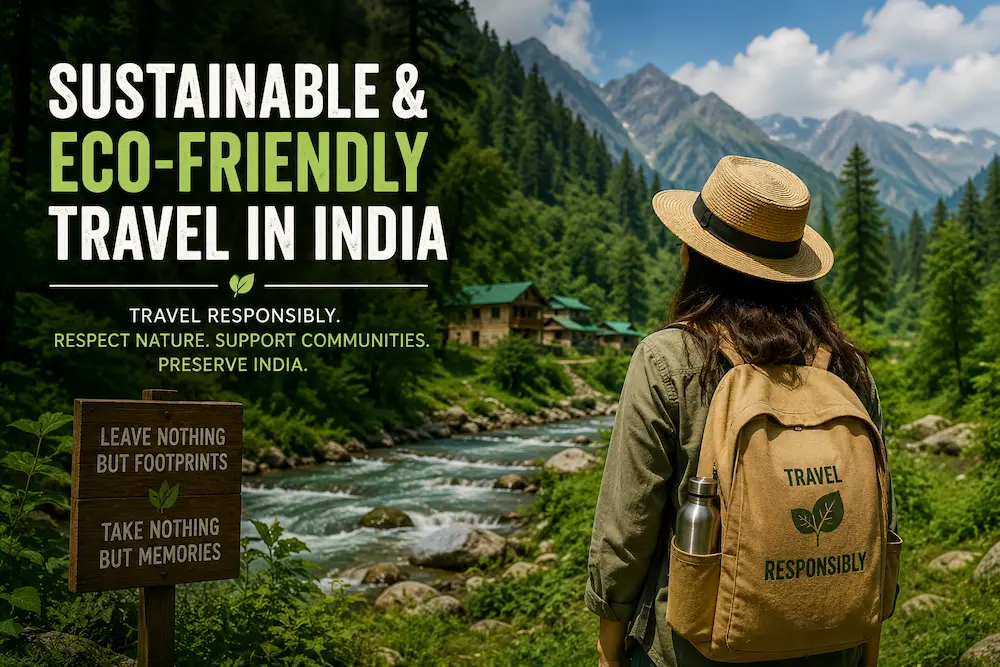
Why Sustainable Travel Matters in India
Tourism brings jobs, income, and investment to India, but rapid or poorly managed growth can place pressure on destinations when local infrastructure and ecosystems cannot keep pace. Some heavily visited destinations have experienced challenges related to overcrowding, traffic, waste management, water availability, and pressure on natural areas. India’s sustainable tourism framework recognises risks associated with tourism, including environmental degradation, pollution, wildlife disturbance, and pressure on land and water resources.
Waste is one of the most visible challenges. Popular destinations can experience sharp increases in plastic, sewage, and solid waste during busy periods, particularly where local collection and treatment systems have limited capacity. Mountain regions can face additional difficulties because steep terrain, dispersed settlements, and limited disposal infrastructure can make waste collection and treatment more challenging. Coastal areas face different pressures when litter and inadequately treated wastewater reach beaches, wetlands, and marine environments.
Water consumption is another consideration. Hotels, resorts, restaurants, and other tourist facilities can increase demand in destinations where water resources are already limited, particularly during peak travel periods. In some Himalayan destinations, rapid increases in visitor numbers can place additional pressure on local water supplies and infrastructure.
Overcrowding can also affect both residents and travellers. Heavy visitor concentrations may contribute to traffic, pressure for new construction, wear on trails and public spaces, and disturbance of sensitive habitats. Wildlife tourism requires particular care because vehicle movement, noise, feeding, and attempts to obtain closer animal sightings can interfere with wildlife and their natural behaviour.
Sustainable travel matters because tourism should create value for destinations while limiting avoidable environmental and social costs. Choosing locally owned accommodation, guides, transport, food, and experiences can help keep more tourism income within local economies. Meaningful community participation in tourism planning and benefit-sharing can also strengthen local support for conservation and make tourism more beneficial to the people who live in the destination.
Sustainable Travel in India at a Glance
Sustainable travel in India does not require perfect choices or giving up comfort. It is about reducing avoidable environmental impacts while respecting wildlife, local communities, cultures, and resources. The table below summarises the practical choices covered in this guide, so you can quickly see where small changes can make your trip more responsible.
| Area | What to Do | What to Avoid |
|---|---|---|
| Transportation | Prefer trains and public transport where practical; walk, cycle or share rides for suitable short journeys | Unnecessary flights, repeated private-car journeys and empty return trips |
| Accommodation | Look for transparent water, energy and waste practices; consider locally owned stays | Trusting vague “eco-friendly” claims or green logos without evidence |
| Wildlife | Follow park rules, maintain distance, keep noise low and choose responsible operators | Feeding, chasing, blocking or deliberately disturbing animals for photographs |
| Food | Try local and seasonal food, support local restaurants and order according to your appetite | Excessive packaging, unnecessary food waste and prioritising convenience over hygiene |
| Culture & Communities | Respect dress codes, ask before photographing people, follow religious customs and respect private spaces | Treating people, rituals or communities as tourist attractions |
| Pilgrimage & Spiritual Places | Follow entry rules, dress appropriately, respect worship and observe photography restrictions | Interrupting ceremonies, touching sacred objects without permission or taking intrusive photographs |
| Plastic & Waste | Carry reusable essentials, reduce single-use items, segregate waste and carry rubbish until proper disposal is available | Littering, unnecessary packaging and assuming every destination has adequate waste facilities |
| Water Use | Refill from safe sources, take shorter showers and avoid unnecessary water use | Wasting drinking water or using large amounts where local supplies are limited |
| Shopping & Souvenirs | Buy useful, locally made products from traceable sources and support artisans where possible | Wildlife-derived products, unclear-provenance items and unnecessary mass-produced souvenirs |
| Greenwashing | Look for specific actions, measurable practices, certifications and transparent policies | Assuming words such as “green,” “natural” or “eco-friendly” prove responsible operation |
Choose Sustainable Transportation in India
Transport can be one of the most significant sources of environmental impact during a trip, particularly when travellers make unnecessary or inefficient journeys. Reducing that impact does not mean avoiding travel. A more practical approach is to match the mode of transport to the distance, route, time available, budget, and local conditions.
Prefer trains for long journeys
For suitable intercity routes, trains can provide a practical alternative to flights or long private-vehicle journeys. Indian Railways carried about 6.9 billion passengers in 2023–24 and had 69,181 route kilometres, illustrating the scale of India’s rail network. Overnight trains can also make an itinerary more efficient by combining transport with a night’s rest and, in some cases, reducing the need for a separate hotel night. Book early for popular routes, allow some flexibility for delays, and compare the complete journey rather than assuming that one transport option will always be better.
Use public transport in cities
Metro systems, local trains, city buses, and shared auto-rickshaws can reduce congestion and emissions per passenger. They can also help travellers avoid parking difficulties and traffic in cities such as Delhi, Mumbai, Bengaluru, Kolkata, and Jaipur. Use route-planning tools, travel outside peak hours when possible, and keep small notes or a suitable digital payment option available.
Walk, cycle, or share
Walk between nearby attractions when roads, heat, traffic, accessibility, and safety conditions permit. For short distances, cycling or an organised bicycle rental may work well, particularly in quieter towns and suitable areas. Where walking or cycling is impractical, consider shared autos, app-based shared rides where available, taxis with several passengers, or group transfers instead of separate cars.
When flying makes sense
Flights can still be a reasonable choice when the journey is extremely long, rail connections are unavailable, time is limited, or road travel would require an exhausting or inefficient detour. If you fly, avoid unnecessary connections where practical, choose reasonably direct routes when available, and consider public transport for airport transfers where suitable.
Reduce unnecessary private-vehicle use
A private car or taxi is not automatically the lower-impact option simply because it offers convenience. Avoid empty return trips, repeated hotel-to-attraction drives, and short journeys that can reasonably be walked or shared. For remote areas, hiring a local driver for a planned circuit can be more efficient than arranging separate point-to-point vehicles each day.
Choose Sustainable Accommodation in India
“Eco-friendly” is not a guarantee of responsible operation. Treat it as a claim to verify, not a feature to accept at face value. A credible property should be able to explain what it does, how it measures progress, and who benefits from its business.
Check Water Practices
Look for rainwater harvesting, low-flow fixtures, leak monitoring, wastewater treatment, and, where appropriate, greywater reuse for landscaping or cleaning. Linen-reuse notices alone are not enough. In water-stressed destinations, ask whether the property relies on groundwater or another local source, such as a borewell, and how its water consumption is monitored. India’s sustainable tourism framework recommends measures such as reducing water leakages and reusing water where possible.
Examine Energy and Waste Systems
Useful indicators include solar power, efficient lighting and cooling, passive design, and energy monitoring. For waste, look for source segregation, composting, recycling partnerships, and a clear plan for food waste. Avoid properties that replace plastic bottles with decorative “eco” packaging but provide no explanation of how the materials are reused, recycled, or disposed of.
Look Beyond the Building
Sustainability also includes people and supply chains. Prefer accommodation that employs local residents, including in supervisory roles where feasible, buys food and materials locally, and works with community organisations. Buying from nearby producers can support local economies and may reduce some transport-related impacts, although food production, seasonality, and food waste also matter.
Verify Certifications and Claims
Recognised sustainability schemes can provide more confidence than an unverified green logo. In India, relevant certification and assessment programmes include recognised schemes such as Green Key and standards aligned with the Global Sustainable Tourism Council. Certification can provide additional confidence, but it does not mean every aspect of a property’s operation is automatically sustainable. Look for transparent criteria, current validity, measurable targets, and publicly available policies.
Before booking, ask whether drinking water is refilled rather than supplied in disposable bottles, whether toiletries are refillable, and how waste and wastewater are handled. A responsible property should answer clearly rather than rely on vague terms such as “natural,” “green,” or “close to nature.”
Travel Responsibly Around Wildlife in India
Wildlife tourism should allow animals to behave naturally, not turn their habitat into a stage for visitors. Your conduct can affect animal welfare, visitor safety, and the protection of sensitive habitats.
Follow Official Rules
Read the park or sanctuary’s instructions before entering and follow directions from forest officials, guides, and drivers. Stay on designated safari roads, trekking routes, boardwalks, and viewing areas. Do not leave a vehicle or enter restricted zones unless specifically authorised. Rules can differ between parks, so do not assume that permission granted in one reserve applies elsewhere.
Keep Your Distance
Never approach, surround, block, or attempt to touch an animal. Maintain the distance specified by the reserve. National Tiger Conservation Authority guidance, for example, includes a minimum viewing distance in certain tiger-reserve contexts, while particular situations may require greater separation. Distance requirements and recommended viewing practices can vary by species, reserve, and circumstances.
Keeping a respectful distance gives animals more space to move away and reduces the likelihood of disturbing or stressing them.
Never feed wildlife or use food, calls, whistles, lights, or other tricks to attract it. Such practices are prohibited or restricted in many protected areas and can alter natural behaviour or encourage animals to associate people, vehicles, or camps with food.
Reject Harmful Sightings
If a driver or guide appears to be deliberately approaching, blocking, circling, or disturbing an animal for a better sighting, ask them to stop when it is safe and appropriate to do so. A good sighting does not justify disturbing the animal. Keep voices low, turn off music, and avoid sudden movement.
Follow restrictions on flash, drones, tripods, and photography in sensitive areas. Do not prioritise a close photograph over safety or animal welfare.
Choose Operators Carefully
Choose authorised or properly registered operators where required, and look for those who follow park limits, route rules, and wildlife guidelines. Where available, trained naturalists or knowledgeable local guides can add value without encouraging intrusive behaviour. Ask how the operator handles crowding, waste, vehicle behaviour, and local employment.
Eat More Responsibly While Travelling in India
Food is one of the easiest parts of a trip to make more local and less wasteful. What you eat—and where you spend—can support regional producers, small restaurants, and food traditions while reducing unnecessary packaging and discarded meals.
Choose Local and Seasonal Food
Try dishes associated with the region rather than relying mainly on familiar chain restaurants or the same types of food you could find anywhere. In Kerala, this might mean a regional fish curry; in Rajasthan, millet-based dishes; in Assam, local rice and fish preparations. Seasonal produce may be easier to source locally and can sometimes require less long-distance transport or storage, although the environmental impact of food also depends on how and where it is produced. Eating regional food can also give your trip a stronger connection to the place rather than offering the same menu everywhere.
Support Local Restaurants
Eat at independently owned restaurants, family-run cafés, traditional food stalls, and local markets where hygiene standards are satisfactory. Spending directly with these businesses can help keep more tourism income within the destination. India’s eco-tourism strategy emphasises community participation in the tourism value chain, including opportunities for local enterprises to benefit from tourism.
Prevent Food Waste
Order according to your appetite, especially when portions are unfamiliar. Share large dishes, request smaller servings where available, and carry leftovers only if you can store and eat them safely. Avoid filling hotel plates simply because a buffet is included. Hospitality food-waste guidance generally prioritises preventing avoidable waste first, followed where appropriate by safe redistribution and treatment such as composting. As a traveller, one of the simplest ways to help is to order only what you are likely to eat.
Reduce Packaging
Carry a reusable bottle, cup, and, when useful, a leak-proof food container. Refill drinking water at trusted stations or your accommodation rather than repeatedly buying small plastic bottles. Choose fresh snacks from local shops or markets over individually packaged alternatives when hygiene and storage conditions are suitable.
You do not need to reject every packaged product. For long train journeys, remote routes, or hot weather, sealed food and drinks can be practical. Buy larger packs only when you can finish or share them, avoid unnecessary straws and disposable cutlery, and dispose of packaging through the available waste-segregation system.
Respect Local Culture and Communities
Sustainability is not limited to reducing plastic or saving water. It also concerns how visitors behave around people, traditions, and places that are part of everyday life—not simply attractions on an itinerary. India’s tourism guidance also recognises the importance of respecting local communities, cultural heritage, safety, and local identity.
Dress Appropriately Where Expected
Clothing that is comfortable for travel may not be suitable everywhere. In conservative areas and religious spaces, you may need to cover your shoulders, knees, or other areas specified by the site. Carry a scarf or shawl where useful and follow any specific instructions at the entrance. Dress codes vary, so observe local practice rather than assuming one rule applies across India.
Ask Before Photographing People
A camera does not create permission. Ask before photographing identifiable individuals, homes, workers, children, ceremonies, or private activities, and accept a refusal without argument. Official cultural-sensitivity guidance also recommends seeking permission in religious or private spaces and obeying photography restrictions.
Respect Religious Places and Ceremonies
Remove footwear where required, keep noise low where quiet is expected, avoid touching sacred objects, and follow queues and instructions. Some sites prohibit photography entirely, while others restrict it to particular areas. Do not turn a ritual into a photo opportunity or interrupt worship for a better frame.
Follow Local Customs
Learn a few basic words such as namaste, dhanyavaad, or a local greeting used in the area. Ask before entering private property, joining a ceremony, or handling objects in a home or shrine. Small efforts to understand local etiquette can help prevent misunderstandings.
Avoid Treating Communities as Attractions
A village, neighbourhood, or local community is not a living museum. Avoid intrusive behaviour such as staring, making personal comments, or handing out money or sweets to children simply because they are part of a tourist encounter. Choose locally run tours that explain how residents participate and benefit, rather than experiences that stage poverty or private life for visitors.
Not every cultural practice is an “experience” waiting to be consumed. Sometimes responsible travel means observing quietly, accepting a boundary, and allowing ordinary life to remain ordinary.
Travel Responsibly at Pilgrimage and Spiritual Places
India’s pilgrimage sites and spiritual destinations are places of worship, reflection, community life, and cultural heritage—not simply tourist attractions. Travellers may visit them for religious reasons, cultural interest, architecture, or curiosity, but the same basic principle applies: your presence should not interfere with worship or everyday religious life.
Understand the Purpose of the Place
Before visiting a temple, mosque, gurdwara, church, monastery, shrine, ashram, or other spiritual site, learn the basic customs and restrictions. Some places welcome visitors freely, while others limit access to particular areas or have separate arrangements for non-worshippers. Check official information where available rather than relying entirely on assumptions or advice from informal sources.
Follow Dress and Entry Customs
Dress according to the expectations of the place you are visiting. Some sites may require covered shoulders or legs, while others may have specific rules for head coverings or other forms of dress. Remove footwear where required and follow instructions about where shoes, bags, or other belongings should be left.
Do not enter restricted areas simply because they appear accessible. If a space is reserved for worshippers, priests, monks, volunteers, or other authorised people, respect the boundary.
Be Respectful During Rituals and Worship
Keep your voice low when quiet is expected, avoid interrupting prayers or ceremonies, and follow queues and instructions from site staff or worshippers. Do not touch religious objects, offerings, people, or ceremonial items unless you are explicitly invited to do so.
If you are unsure about what to do, observing what others do and asking politely is usually better than guessing.
Ask Before Taking Photographs
Photography rules can vary considerably between religious sites. Some allow photography in designated areas, while others prohibit cameras or photography altogether. Look for signs and follow instructions from the site.
Even when photography is permitted, avoid photographing people during private or sensitive moments without permission. Do not use flash, drones, selfie sticks, or other equipment where they are prohibited or likely to disturb worship.
A ceremony should not be interrupted because you want a better photograph.
Treat Pilgrims and Worshippers With Respect
People visiting a pilgrimage site may be experiencing a deeply personal religious moment. Avoid staring, making intrusive comments, or treating worshippers as part of the attraction. Give people appropriate space, particularly during prayers, processions, bathing rituals, or other ceremonies.
If a procession, prayer, or religious activity temporarily changes access to an area, be patient rather than treating it as an inconvenience.
Reduce Plastic, Waste and Water Use While Travelling
Small decisions during a trip can reduce avoidable waste, particularly in mountain, coastal, and heritage destinations where collection and disposal systems may have limited capacity. India’s Travel for LiFE campaign encourages travellers to carry reusable bottles and cloth bags, avoid single-use plastic, and use water responsibly.
Carry a Reusable Bottle
Take a durable bottle and refill it only from a verified safe source, such as your accommodation, a filtered-water station, or a trusted refill point. Do not assume that clear water is safe to drink. In remote areas, ask your accommodation about its filtration system and consider an appropriate water-treatment method, such as purification tablets or a suitable filter, if necessary.
Reduce Single-Use Plastic
Decline disposable straws, cups, cutlery, takeaway containers, and small toiletry bottles when a reusable or refillable alternative is available. Carry a cloth shopping bag and use it for market purchases, snacks, and everyday shopping. A reusable bottle is useful, but reducing the number of items you consume remains more important than simply replacing disposable products with reusable ones.
Avoid Excess Packaging
Choose loose fruit, local snacks, and food served in reusable containers or packaging that can be appropriately collected and recycled locally, where hygiene standards are satisfactory. Buy quantities you can finish or share rather than several individually wrapped portions. For long journeys, reusable food containers can help with packed meals and leftovers.
Dispose of Waste Properly
Use designated bins and follow local instructions for separating wet, dry, recyclable, and non-recyclable waste. If bins are absent or overflowing, keep your waste in a sealed bag until you reach a suitable collection point or accommodation that can handle it properly. Do not leave wrappers, tissues, bottles, or food scraps on beaches, trails, roadsides, campsites, or near water. Responsible-travel guidance encourages travellers to carry waste until it can be segregated and handled appropriately.
Use Water Thoughtfully
Take shorter showers, turn off taps while brushing your teeth, and report leaks. Reuse towels when practical, but do not treat a linen-reuse card as evidence that a property manages water responsibly. Avoid wasting drinking water and do not use large amounts of water for unnecessary washing of clothes, vehicles, or equipment, particularly where local supplies are limited. Where water restrictions exist, follow them carefully.
Shop Responsibly and Choose Better Souvenirs
Souvenirs can be more than reminders of a trip: they can direct money towards local makers and traditional skills. They can also contribute to waste, cultural exploitation, or illegal wildlife trade when their origin is unclear. The most responsible choice is usually something made locally, used regularly, and bought from a seller who can explain its source.
Buy Locally Made Products
Look for handloom textiles, pottery, bamboo or cane work, regional foods, woodcraft from legal and traceable sources, and other products associated with the area. Buy from artisan cooperatives, craft collectives, fair-trade groups, or small workshops where possible. Buying closer to the source can make it easier to identify who produced an item and may allow a greater share of the purchase price to reach the maker.
Ask Where Products Come From
A simple question—“Where was this made?”—can reveal whether an item is genuinely local or mass-produced elsewhere. Ask about the material, maker, and production process, particularly when a seller presents something as handmade, traditional, or community-made. Keep receipts for expensive purchases and check any rules governing the transport of textiles, antiques, wood, or food products.
Avoid Wildlife-Derived Souvenirs
As a practical rule, avoid wildlife-derived souvenirs unless you have verified that the item is legal and appropriately sourced. Ivory, animal bones, skins, feathers, turtle shell, coral, seahorses, starfish, and other wildlife-derived materials can be subject to legal restrictions in India, while international movement can also involve CITES requirements. Be cautious of claims that an item is “old,” “naturally collected,” or “just a replica” unless its material and provenance are clear.
Choose Useful Over Mass-Produced
A durable scarf, locally made notebook, spice blend, basket, or piece of pottery may be more useful and meaningful than a generic plastic magnet or imported trinket. More importantly, avoid buying objects you do not need simply because they are cheap or heavily promoted. The most sustainable souvenir is often one that you will actually use rather than eventually discard.
Bargain Respectfully
Negotiation is common in many Indian markets, but do not treat bargaining as a contest or push prices below what seems fair. Ask the price politely, make a reasonable counteroffer, and walk away if it does not fit your budget. Remember that the person selling an item may have limited control over the final price, and a small saving for a traveller can represent meaningful income to someone in the local supply chain.
Supporting local craft traditions can be part of responsible tourism when purchases are made thoughtfully and the people producing or selling the goods are treated fairly.
Avoid Greenwashing When Choosing Travel Services
A travel company can use words such as eco, green, responsible, or nature-friendly without explaining what those claims mean. The most useful approach is to look for specific, verifiable practices rather than polished marketing language.
Do Not Rely on “Eco”
The word “eco” is not evidence of responsible operation. A hotel may have eliminated plastic straws as one improvement while still using large amounts of groundwater, or advertise a nature-based experience that disturbs wildlife. Treat broad environmental language as a reason to ask further questions rather than as proof of overall sustainability.
Look for Measurable Practices
A credible provider should be able to explain how it:
Reduces and segregates waste.
Treats wastewater and manages sewage.
Monitors water and energy consumption.
Uses renewable energy or efficient equipment.
Manages vehicle numbers, group sizes, or visitor numbers where relevant.
Avoids disturbing wildlife and sensitive habitats.
Specific details are more useful than claims such as “we care for nature.” Ask what happens to waste after collection, where drinking water comes from, and whether the business measures its resource use.
Check Community Benefits
Find out whether local residents are employed, trained, or involved in decision-making. Ask whether the operator uses local guides, buys from nearby producers, supports community projects, or shares revenue with conservation and local organisations. A service that relies heavily on staff and supplies from outside the destination, while simply operating in a rural area, may provide fewer local economic benefits than its marketing suggests.
Look for Transparency
Reliable businesses may publish a sustainability policy, targets, progress updates, supplier standards, or explanations of their conservation work. They should be willing to answer reasonable questions and acknowledge limitations. Sustainability claims should be supported by current actions or records rather than promises about an undefined future.
Understand Certifications
A logo is meaningful only when you can identify the organisation, criteria, validity period, and assessment process. Tourism businesses certified under a GSTC-recognised certification scheme are assessed through certification bodies that meet GSTC’s accreditation requirements, rather than relying solely on self-declaration. Other national or regional schemes may also be useful, but check what they actually evaluate and whether assessment is independent.
Be cautious when a provider offers no evidence, avoids direct questions, uses only vague phrases, or promotes one minor initiative as proof of overall sustainability. Genuine responsible travel is usually specific, transparent, and open about areas that still need improvement.
Plan a Lower-Impact India Trip
A lower-impact trip begins before you book transport or accommodation. The aim is not to travel perfectly, but to reduce avoidable pressure on destinations while helping more of your spending reach local people and businesses. India’s Travel for LiFE programme recommends public or shared transport, low-impact local travel, reduced water use, avoidance of single-use plastic, waste segregation, and responsible behaviour in protected areas.
Choose Fewer Places
Avoid building an itinerary around too many cities and long transfers. Staying longer in fewer destinations can reduce transport, rushed sightseeing, and repeated hotel check-ins. Before visiting a popular hill station, beach, island, wildlife reserve, or pilgrimage centre, check seasonal restrictions, entry systems, road conditions, permits, and local visitor-management measures.
Plan Transport Carefully
Use trains for suitable long-distance journeys and public transport for urban travel. Walk or cycle for short distances when conditions are safe, and use shared autos, taxis, or group transfers where practical. Fly when distance, limited rail access, or time constraints make it reasonable, but avoid unnecessary short flights and inefficient backtracking.
Book Accommodation With Evidence
Choose properties that can explain their water, energy, sewage, waste, and employment practices. Look for locally owned stays, trained local staff, refill systems, renewable energy, and transparent sustainability information. Do not rely only on labels such as “eco,” “green,” or “nature-friendly” without checking what the property actually does.
Keep Spending Local
Hire local guides, eat at independent restaurants, buy directly from artisans, and choose community-run experiences where appropriate. Where licensing applies, choose wildlife operators that are properly licensed and follow park or reserve rules. Avoid activities that involve feeding, touching, chasing, or deliberately disturbing animals.
Pack and Behave Thoughtfully
Carry a reusable bottle, cloth bag, and small food container where useful. Use water carefully, refuse unnecessary packaging, segregate waste, and carry rubbish until you find an appropriate disposal point. Dress and behave respectfully, ask before photographing people, and remember that not every local custom or community is a visitor attraction.
Respect Local Limits
Follow visitor caps, permits, timed-entry systems, conservation rules, and temporary restrictions when they apply. Do not try to bypass limits because a destination is busy or a particular experience is important to your itinerary. Respecting local capacity measures helps reduce pressure on infrastructure, resources, wildlife, heritage sites, and community life.
A practical itinerary might combine a train journey, two or three nights in a locally run homestay or accommodation with transparent sustainability practices, independent restaurants, a responsible nature guide, and walking or shared transport for local visits. This approach is often simpler, slower, and more connected to the destination—not merely more “green.”
My Approach to Sustainable Travel in India
Living in India has shaped the way I think about sustainable travel. I do not see it as a checklist that visitors must follow perfectly, or as a label reserved for expensive eco-resorts and remote destinations. For me, it is about paying attention to how I move through a place and recognising that every journey uses local resources and affects local lives.
I try to choose trains for suitable long-distance routes and use public transport, shared autos, or walking when I am exploring a city. These options are not always the easiest, fastest, or most comfortable, particularly when travelling with heavy luggage or navigating unfamiliar areas. Sustainability has to remain practical; I would rather make sensible choices consistently than follow an ideal that is impossible to maintain.
I also prefer staying longer in fewer places. A slower itinerary can reduce unnecessary transfers and gives me more opportunities to spend with local restaurants, guides, drivers, homestays, and small businesses. When I book accommodation, I look beyond the word “eco” and try to understand how the property manages water, waste, energy, and local employment.
My habits are simple: I carry a reusable bottle and cloth bag, avoid unnecessary packaging, use water carefully, and keep waste with me when disposal facilities are unavailable. Around wildlife and religious sites, I follow local rules even when they limit what I can photograph or experience.
I know that individual choices cannot solve every problem created by tourism. Infrastructure, regulation, and destination planning matter just as much. But travellers can still influence demand. In India, where destinations vary so widely in ecology, culture, and infrastructure, travelling responsibly means adapting to each place rather than applying one fixed formula.
For me, it means being a considerate guest, spending thoughtfully, and accepting that sometimes the most respectful choice is to slow down, step back, or leave something unseen.