
Visiting India involves more than planning your trip; it also means understanding and adapting to different social customs. India has no single set of etiquette rules; customs are shaped by region, religion, community, and context. What feels natural in a Mumbai café may be less appropriate in a rural village in Bihar, while a gesture of respect in one setting may be understood differently elsewhere.
This diversity is why visitors may encounter unfamiliar customs: distinctive head movements whose meaning is not always immediately obvious, shoes removed at doorways, food traditionally offered with the right hand, and greeting customs that may differ from what you’re accustomed to. There is no universal Indian rulebook. Instead, the most reliable approach is practical: observe what people around you are doing, ask politely when unsure, and adapt your behaviour to the setting. This guide offers practical, situational advice to help you travel through India with confidence and cultural sensitivity.
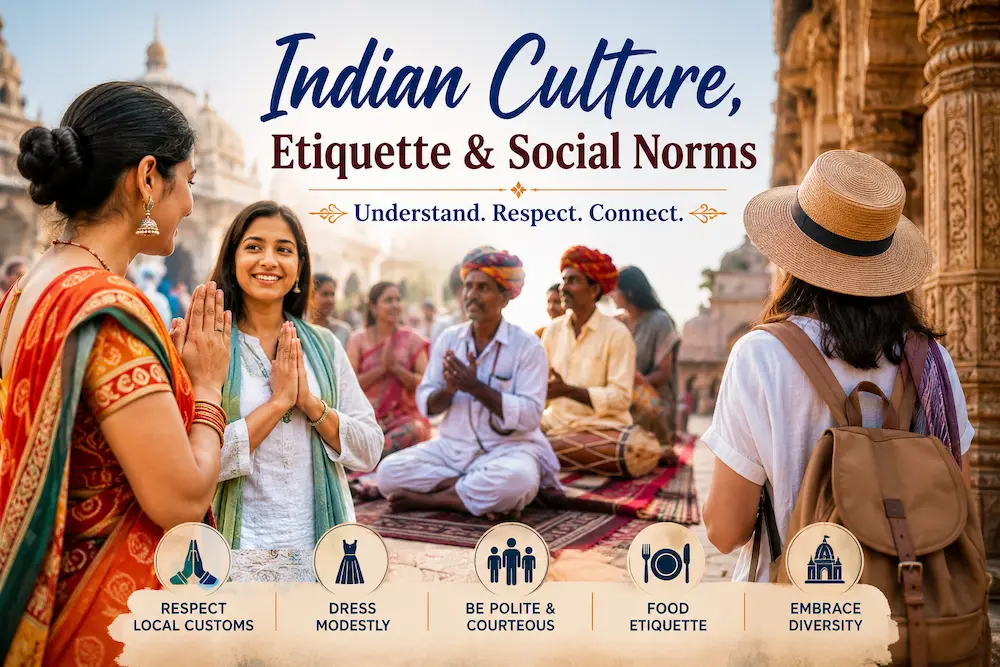
Understanding Indian Culture Before You Visit
India isn’t culturally uniform. It is a diverse country where customs and social expectations can vary considerably by region, language, community, religion, and setting. Travelers who expect one universal “Indian culture” may quickly discover that what feels natural in one part of the country can be different elsewhere.
Regional differences can be seen in languages, cuisines, clothing, festivals, religious practices, and everyday social customs. A visitor’s experience in Kerala, for example, can feel quite different from one in Rajasthan, Punjab, West Bengal, or Meghalaya. This doesn’t mean that every state or community follows a completely separate set of rules; rather, local context often matters more than broad national assumptions.
India’s religious diversity also shapes everyday life. Hinduism is the majority religion, alongside large Muslim, Christian, Sikh, Buddhist, and Jain communities, as well as many other traditions. Religious practices can influence food, clothing, festivals, daily routines, and expectations at places of worship. For travelers, the practical lesson is simple: follow the specific customs of the place you are visiting rather than assuming that one rule applies everywhere.
Urban and rural settings can also differ, although there is no universal pattern. Larger cities may offer a wider range of social norms, while some rural or close-knit communities may have more conservative expectations around dress, gender interaction, and public behaviour. Observing the people around you is often the easiest way to understand the appropriate level of formality.
Family plays an important role in social life across much of India, and elders are often treated with particular respect. Hospitality is also an important part of many social interactions; visitors may be offered tea, food, or a place to sit even during an informal visit. Responding warmly and respectfully is usually more important than knowing every cultural detail in advance.
For travelers, understanding this cultural variety is less about memorising rules and more about learning to read the setting. Observe first, ask when unsure, and adapt respectfully. That approach will serve you better than assuming that one definition of “Indian etiquette” applies everywhere.
Quick India Etiquette: Do’s & Don’ts
| Do’s | Don’ts |
|---|---|
| Observe local customs and adapt to the setting. | Don’t assume one etiquette rule applies across all of India. |
| Dress more modestly when visiting religious or conservative places. | Don’t treat religious spaces as ordinary tourist attractions. |
| Ask before photographing people, ceremonies, or private spaces. | Don’t photograph someone who has asked you not to. |
| Remove your shoes when required and follow posted instructions. | Don’t enter restricted areas or ignore signs at religious sites. |
| Use your right hand when eating or offering food where this is customary. | Don’t assume every dining situation follows traditional practices. |
| Greet people according to the formality of the situation and local setting. | Don’t assume that everyone prefers the same form of greeting or physical contact. |
| Be patient and respectful when bargaining in markets where bargaining is expected. | Don’t turn bargaining into an aggressive or disrespectful exchange. |
| Treat elders, hosts, workers, and local communities with courtesy. | Don’t assume that every interaction will follow the social norms you’re used to at home. |
| Ask politely when you’re unsure about a custom. | Don’t be embarrassed by an innocent mistake—learn and adjust. |
Greetings & Everyday Social Etiquette
In India, the right greeting depends less on a rigid rule and more on reading the setting: who you’re meeting, how formal the situation is, and whether physical contact feels appropriate.
How to greet people
Namaste—palms pressed together at chest level with a slight nod—is a widely recognised and respectful greeting. It can be particularly useful when you’re unsure whether physical contact is appropriate, and you may encounter it in homes, religious places, shops, and everyday interactions.
Handshakes are common in many professional and urban settings. Where you’re unsure whether someone is comfortable with physical contact, allowing the other person to initiate can be a considerate approach. In informal situations, a simple “Hello” or “Hi” is widely understood, particularly in cities. A smile and friendly tone often matter more than choosing the perfect greeting.
Addressing people respectfully
In many settings, particularly when speaking with elders or in formal situations, people may use titles or honorifics rather than addressing someone by their first name alone. “Sir” and “Ma’am” are commonly heard in professional and service interactions.
Depending on the region, age, and relationship, you may also hear respectful terms such as “Aunty” and “Uncle” used for older adults who are not literal relatives. You may also encounter “ji” added after someone’s name as a sign of respect. If you’re unsure, using the person’s name politely or following the formality they use with you is usually a good approach.
Personal space and body language
Expectations around physical contact vary considerably by relationship, setting, age, gender, and community. In more formal or conservative situations, it is generally better not to assume that hugs, back-slaps, or cheek kisses are welcome.
Pointing directly at someone with a single finger can sometimes feel abrupt; when appropriate, an open hand or a gesture in the person’s direction can feel more courteous. Prolonged staring can also make people uncomfortable, particularly when directed at someone going about their daily life.
You don’t need to memorise every gesture. A calm tone, respectful body language, and paying attention to how people around you interact will usually help you respond appropriately.
Clothing & Dress Etiquette
Dress in India is less about a single code and more about matching your clothing to the setting: a Delhi café, a village in Bihar, a temple in Tamil Nadu, or a mosque in Kashmir may each have different expectations.
Everyday urban clothing
In many cities, jeans, T-shirts, kurtas, shirts, and casual dresses are common. Dress can be relatively relaxed in malls, cafés, co-working spaces, and tourist-oriented neighbourhoods. Still, choosing slightly more modest clothing can make it easier to adapt when moving between different places and situations.
Rural and conservative community settings
Some rural areas and close-knit communities may have more conservative expectations around dress than major cities. Loose, comfortable clothing that covers the shoulders and knees is often a practical choice when visiting such places, particularly if you will be spending time in homes or community settings.
Religious sites and ceremonies
Modest clothing is generally a good starting point at religious sites, but requirements vary by faith, location, and individual place of worship. Check posted instructions and follow the guidance given locally.
Many Hindu temples expect visitors to dress modestly, and some specifically restrict shorts, sleeveless clothing, or clothing above the knees. Some mosques may ask women to cover their hair or shoulders, while men may also be expected to wear clothing covering the shoulders and legs. A lightweight scarf can be useful when visiting places where head covering is expected.
Many Buddhist monasteries and religious ceremonies also favour modest clothing. When unsure, observe what visitors are wearing and follow the site’s specific instructions.
Beaches
Dress expectations are generally more relaxed at beaches and resorts, although local norms can vary. Swimwear is best kept to the beach or pool area; cover up when walking through markets, residential areas, or other public spaces away from the beach.
Footwear
Shoes are commonly removed before entering temples, mosques, monasteries, and private homes, although the exact practice varies. Look for signs, shoe racks, or follow what others are doing.
In many religious and traditional settings, showing the soles of your feet toward a shrine, sacred object, or another person may be considered disrespectful. When sitting, keeping your feet to the side or tucked away is a simple way to avoid this.
Photography & Interacting With Local People
Photography is common across much of India, but attitudes toward being photographed vary by person, place, and situation. The ethical line is simple: people are not props. Treat every portrait as a small social interaction, not just a photograph. For close-ups or clearly identifiable portraits, ask first. A simple “Photo?” in English or the local language can be a polite way to ask, but pay attention to the person’s response rather than assuming silence means yes. If someone hesitates, looks away, or says no, respect that immediately.
With children, never rely on enthusiasm alone. Ask a parent or guardian for permission and still pay attention to the child’s comfort. If they shy away, cover their face, or move out of frame, stop. Avoid posting images that reveal school names, uniforms, or precise locations.
Many temples, mosques, and inner prayer areas restrict photography, particularly during rituals. Look for signs, observe what others are doing, and ask a caretaker or staff member if unsure. Do not enter homes, small shops, or private areas to take photographs without explicit permission.
Photography restrictions apply at some airports, military installations, border areas, government facilities, infrastructure sites, and other security-sensitive locations. Follow posted restrictions and instructions from security personnel, and never cross barriers or enter restricted areas for a photograph. Drone use is also restricted around many sensitive locations, so check the current rules before flying.
In busy markets, wide scenes can often be photographed without focusing on individuals. If you want a closer photograph of a vendor or another identifiable person, a greeting or brief conversation can make the interaction more natural. Buying something does not automatically mean you have permission to photograph the seller.
A refusal may be verbal or non-verbal: a turned head, a hand over the lens, a step back, or another clear sign of discomfort. Treat these as a no. Don’t argue, bargain, or try to capture a “candid” after someone has declined.
Social Etiquette in Public Places
Public life in many parts of India can be lively, crowded, and more energetic than some visitors expect. Queues generally exist, although the experience can vary considerably by place and crowd. At busy stations, ticket counters, and popular attractions, you may encounter crowded or loosely organised lines. Staying calmly in your position and asking politely when unsure is usually more effective than becoming confrontational.
On public transport, expect close proximity, shared seating, and occasional conversations with strangers, particularly during busy periods. Crowding can make personal space limited, so staying patient and aware of those around you is often the easiest approach.
Markets can be similarly busy, with dense crowds, vendors calling out, and a constant flow of activity. Bargaining is common in some street markets, bazaars, and independent shops, but it is not expected everywhere. Supermarkets, malls, restaurants, and many established shops normally use fixed prices. Where bargaining is appropriate, let the seller quote first, make a reasonable counteroffer, and treat the exchange as a friendly negotiation rather than a confrontation. If you cannot agree on a price, it is perfectly fine to thank the seller and walk away.
Noise levels vary by neighbourhood and time of day, but visitors may encounter traffic horns, loud conversations, music from shops, and occasional wedding or religious processions. You can use headphones when appropriate, keep your own voice moderate, and avoid adding to the noise with loud videos or calls in shared spaces.
Interacting with strangers is common in many parts of India. People may ask where you’re from, offer help, or request a selfie, particularly if you are visibly a foreign visitor. A polite “No, thank you” is often enough, although you should feel free to end the interaction or move away if someone continues after you’ve declined.
Public displays of affection can attract different reactions depending on the location and setting. Holding hands may attract little attention in some urban areas, while more intimate displays can draw unwanted attention or disapproval, particularly in more conservative settings. If you’re unsure, keeping affection relatively discreet is the safer social choice.
Public photography follows the same basic principle: be aware of how your camera affects the people around you. Wide scenes are generally less intrusive than deliberately photographing identifiable individuals. If someone objects or appears uncomfortable, stop and move on. For more detailed guidance, see Photography & Interacting With Local People.
Communication & Conversation Etiquette
English is widely used in tourism, business, and many urban settings, but the appropriate level of formality depends on who you’re speaking with and the situation. With hotel staff, drivers, officials, or older people, a polite and slightly formal tone is usually a good starting point. With peers and younger people in cafés or hostels, casual English is generally fine. Switching between English, Hindi, and regional languages in the same conversation is also common in many settings. You don’t need to mirror the language switching; simply follow the conversation naturally.
People may ask questions that feel personal to visitors, such as your age, marital status, occupation, where you’re from, or sometimes your religion. In some social settings, these questions can simply be a way of showing interest or getting to know you. You don’t have to provide details you’re uncomfortable sharing. You can keep answers brief or general, such as “I’m in my thirties,” “I work in education,” or simply “I’m comfortable keeping that private.” You can also change the subject by asking about the other person’s work, family, or hometown.
Family-related questions are common in some social interactions. You may hear questions such as “Are you married?” “Do you have children?” or “Where do your parents live?” If a topic feels too personal, a light response such as “We’ll see,” “Not yet,” or “I prefer not to discuss that” can help you move the conversation on without making the situation unnecessarily awkward.
Religion and politics can be more sensitive topics. Casual conversations about festivals, food, traditions, or places of worship may be perfectly natural, but debates about religious beliefs or party politics can become uncomfortable, particularly among people with different views. As a visitor, it is usually better to listen, ask neutral questions, and avoid assuming that everyone shares the same perspective.
Showing photographs on your phone, such as pictures of your travels or family, may be welcomed as a way to build rapport. At the same time, asking before photographing someone’s home, family members, or religious objects remains important.
Communication can sometimes be indirect, particularly when someone wants to avoid giving a blunt refusal or causing embarrassment. In some situations, a “yes” may simply indicate that someone has understood what you said rather than confirming that something will happen, while “I’ll try” may indicate uncertainty rather than a firm commitment. When something is important—such as a booking, pickup time, price, or travel arrangement—confirm the details clearly rather than relying on an implied agreement.
Common Etiquette Mistakes Travelers Should Avoid
Most etiquette mistakes in India are not intentional; they usually happen when travelers assume that familiar habits, expectations, or social rules will work the same way everywhere. India is culturally diverse, and what feels normal in one city, community, or setting may not be appropriate in another. A little awareness can therefore make everyday interactions much easier and more respectful. Before visiting a religious site, market, home, or local neighbourhood, take a moment to observe what people around you are doing and follow any specific instructions. Be equally mindful when photographing people, choosing what to wear, bargaining, using public transport, or interacting with service staff. You do not need to know every custom in advance, and an innocent mistake does not make you a disrespectful traveler. The better approach is to stay observant, ask politely when unsure, and adapt to the situation rather than assuming that your usual way of doing things is automatically appropriate.
The following are some of the most common etiquette mistakes travelers should avoid when visiting India:
Assuming All of India Follows the Same Customs
Ignoring Religious-Site Instructions
Photographing People Without Asking
Dressing Without Considering the Setting
Bargaining Aggressively
Assuming Every Interaction Has the Same Social Expectations
Treating Religious Practices as Tourist Entertainment
Touching Sacred Objects Without Permission
Ignoring Queues or Local Instructions
Expecting Every Service Interaction to Work Exactly as It Does at Home
What Should You Do If You’re Unsure?
You will not know every local custom before visiting India, and you do not need to. Cultural expectations can vary by region, religion, community, age, and setting, so an unfamiliar situation does not necessarily mean you have done something wrong. When you’re unsure, the simplest approach is to pause, observe, ask politely, and adapt.
Look at how people around you are behaving, particularly when entering a home, religious site, local market, or community space. Check for signs or instructions before taking photographs, entering restricted areas, removing your shoes, or participating in a ceremony. If there is no clear guidance, ask a host, staff member, guide, or another appropriate person rather than guessing.
A simple “Is this okay?”, “Should I remove my shoes?”, or “May I take a photograph?” can prevent an unintended mistake. If someone corrects you, accept the guidance calmly and adjust without becoming defensive.
Most importantly, don’t let the fear of making a cultural mistake stop you from interacting with people. Respectful curiosity matters more than perfect knowledge. When you approach unfamiliar situations with patience and a willingness to learn, you can usually navigate them comfortably while showing consideration for the people and places around you.
Quick India Etiquette Checklist for Travelers
You do not need to memorise every cultural custom before visiting India. A few simple habits can help you navigate everyday situations more comfortably while showing respect for local people, traditions, and places. Keep this checklist handy when moving between cities, religious sites, markets, public transport, and social settings. When expectations are unclear, observe what people around you are doing, ask politely, and adapt to the situation.
| Situation | What to Do | What to Avoid |
|---|---|---|
| Greetings | Use a polite greeting and follow the level of formality around you. | Assuming everyone prefers the same greeting or physical contact. |
| Clothing | Dress according to the setting, especially at religious or conservative places. | Wearing beachwear or very casual clothing where it may be inappropriate. |
| Religious Sites | Follow signs, local instructions, and site-specific customs. | Entering restricted areas or treating worship as entertainment. |
| Shoes | Check whether footwear should be removed before entering. | Assuming shoes are permitted everywhere. |
| Photography | Ask before taking identifiable portraits or photographing private situations. | Photographing people, ceremonies, or restricted areas without permission. |
| Food & Dining | Follow the dining customs of the setting and use your right hand where appropriate. | Assuming every meal follows traditional dining practices. |
| Markets | Bargain politely where bargaining is expected and accept fixed prices elsewhere. | Becoming aggressive or treating bargaining as a confrontation. |
| Public Transport | Be patient with crowds and respect available seating and local instructions. | Pushing, blocking entrances, or ignoring queues and directions. |
| Conversation | Answer personal questions at your comfort level and change the subject when needed. | Assuming every personal question requires a detailed answer. |
| Religion & Politics | Listen respectfully and keep sensitive discussions neutral when appropriate. | Turning conversations into heated debates. |
| Personal Space | Pay attention to the setting and avoid assuming physical contact is welcome. | Hugging, touching, or getting physically familiar without clear comfort. |
| When Unsure | Observe, ask politely, and adapt. | Assuming your usual customs automatically apply. |
My Approach to Indian Etiquette
I don’t think you need to arrive in India knowing every custom, gesture, or social expectation. India is too diverse for a single checklist to cover every situation, and trying to memorise hundreds of rules can actually make travel feel more complicated than it needs to be.
Having grown up around these everyday customs, I know that the small details often matter more than a long list of formal rules.
My approach is simple: observe, ask, and adapt.
When I am unsure about something, I would rather take a moment to watch what people around me are doing or ask politely than assume that my usual way of doing things is appropriate. This is particularly useful at religious sites, in local communities, inside someone’s home, or during unfamiliar social situations.
I also think an innocent mistake should not be treated as a disaster. Travellers will occasionally get something wrong, especially when they are encountering customs that are unfamiliar to them. What matters is how you respond—listen, apologise if necessary, and adjust.
For me, good etiquette is ultimately less about following a perfect set of rules and more about showing respect for people, places, and local customs. If you travel with curiosity rather than assumptions, remain aware of your surroundings, and are willing to adapt, you will be well prepared for the many different social situations you may encounter across India.
You don’t have to understand everything before you arrive. You simply need to be willing to observe, ask, and learn.