
India travel logistics covers the practical systems you need to arrange and use when travelling in India, from transportation and accommodation to internet connectivity, money and payments, and visa and entry procedures. Understanding how these systems work can make it easier to plan bookings, stay connected, make payments, check into accommodation and complete arrival formalities.
This guide brings the key logistics together in one place, with practical information on what to arrange before departure, what to expect on arrival, and how the main travel systems work in India. It covers trains, flights, buses, taxis, accommodation procedures, SIM and eSIM options, mobile connectivity, cash, cards, UPI, currency exchange, e-Visas and immigration requirements.
The information is focused specifically on travel logistics rather than destinations, itineraries, travel styles or budgets. Where requirements, services or procedures can change, we recommend checking the relevant official government, transport, telecom or financial-service source before making important arrangements.
Use this page as your India travel logistics hub, then follow the dedicated guides for detailed information on transportation, accommodation, connectivity, payments, and visa and entry requirements.
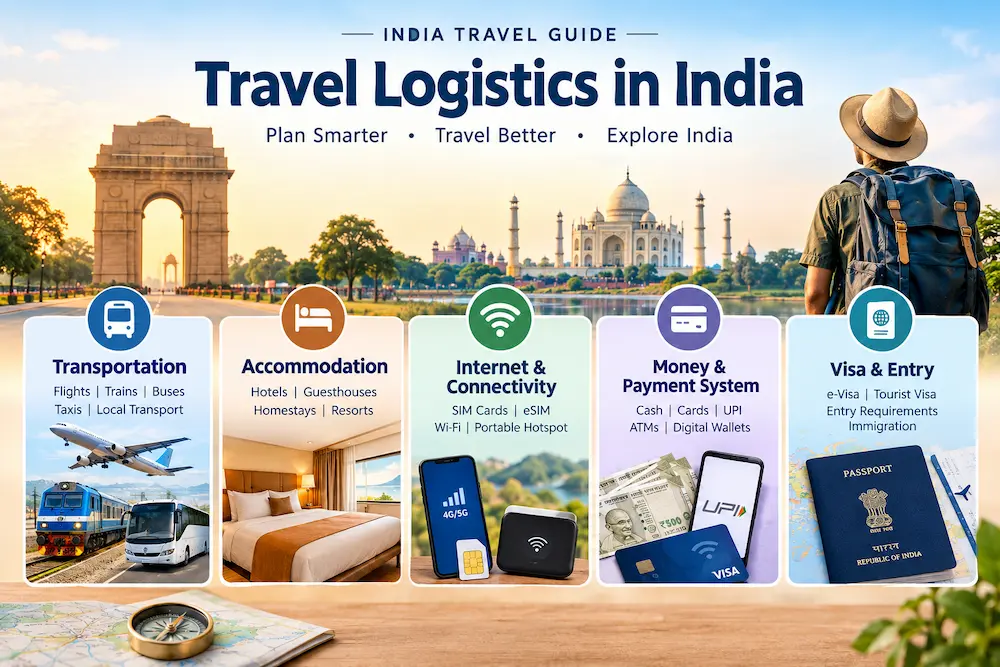
India Travel Logistics — Quick Glance
| Logistics Area | What You’ll Find in This Guide |
|---|---|
| Transportation | Trains, flights, buses, taxis, auto-rickshaws, local transport, vehicle rentals, booking procedures and essential travel documents. |
| Accommodation | Accommodation types, booking procedures, check-in and check-out, identification requirements, payments, deposits and common booking issues. |
| Internet & Connectivity | SIM cards, eSIMs, mobile data, Wi-Fi, international roaming, network coverage, activation and common connectivity issues. |
| Money & Payment System | Indian currency, cash, ATMs, debit and credit cards, UPI, international payments, currency exchange and payment-related issues. |
| Visa & Entry | Visa options, e-Visa, passport requirements, application procedures, immigration, entry requirements, customs and arrival formalities. |
Transport System in India
India’s transport system works as a layered network of domestic flights, railways, buses, taxis, auto-rickshaws and urban public transport. Domestic flights connect major cities and provide faster intercity connections, while railways remain a major option for medium- and long-distance journeys, with services ranging from Rajdhani, Shatabdi and Vande Bharat to conventional sleeper and air-conditioned trains. Foreign travellers may have access to specific railway booking arrangements, subject to current eligibility and procedures. Government and private buses provide additional connections, particularly on routes where rail services are limited. Within cities, travellers can use metro systems, city buses, taxis, app-based cabs and auto-rickshaws, depending on local availability. Booking methods, fares, schedules, luggage rules and payment options can vary between services and operators. Checking current information before departure is therefore important, particularly for tickets and time-sensitive journeys.
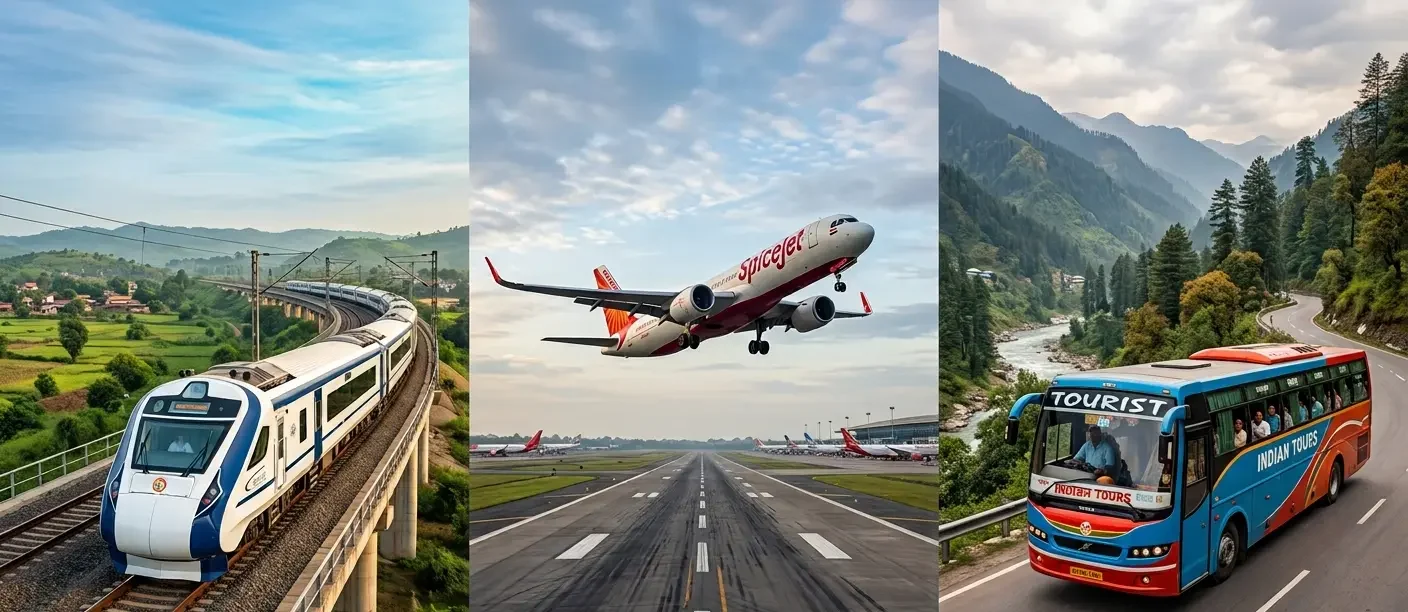
Transport Options at a Glance
| Transport Mode | How It Works |
|---|---|
| Flights | Domestic airlines connect major cities and are booked through airline websites, authorised platforms and travel agencies. |
| Trains | Indian Railways provides extensive intercity services with different train types, classes and ticketing options. |
| Buses | Government and private operators provide scheduled and long-distance services, with booking methods varying by operator. |
| Metro & Local Transit | Metro systems, city buses and other local services provide urban transportation where available. |
| Taxis & App-Based Cabs | Taxis, ride-hailing services and app-based cabs are available in many cities, with fares and booking methods varying. |
| Auto-Rickshaws | Auto-rickshaws are widely used for shorter local journeys, with payment and fare systems differing by location. |
| Vehicle Rentals | Car and two-wheeler rental services are available in some areas, subject to applicable licence and rental requirements. |
Accommodation in India
Accommodation in India ranges from hotels and hostels to homestays, guesthouses, resorts and heritage properties, with booking procedures and facilities varying between properties. When choosing accommodation, travellers should check the property’s exact location, room facilities, check-in and check-out times, identification requirements, payment conditions, cancellation policy and recent guest reviews. Hotels and other registered properties may require identification and guest registration at check-in, while some properties may have additional requirements for international visitors. Bookings can be made through hotel websites, online travel agencies and authorised booking platforms, and confirmation details should be retained until check-in. For late arrivals or early departures, checking reception hours and arrival procedures in advance can help avoid problems. Accommodation policies, taxes, deposits and available payment methods vary by property, so the property’s current terms should always be reviewed before completing a reservation.
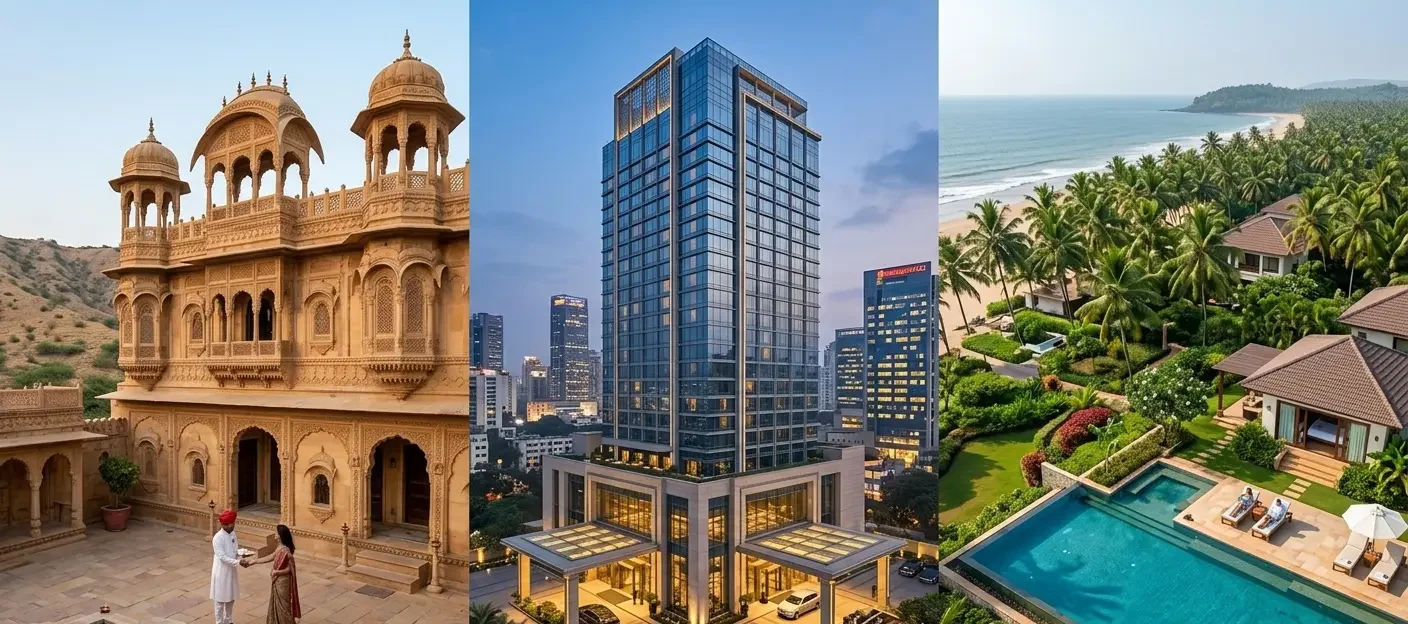
Accommodation Options at a Glance
| Accommodation Type | How It Works |
|---|---|
| Hotels | Hotels provide private rooms with services and facilities that vary by property, category and location. |
| Hostels | Hostels generally offer shared dormitory accommodation, with some properties also providing private rooms and common facilities. |
| Homestays | Homestays provide accommodation within or alongside a residential property, with facilities and host arrangements varying by property. |
| Guesthouses | Guesthouses typically provide simpler accommodation with fewer services than full-service hotels, depending on the property. |
| Serviced Apartments | Serviced apartments combine accommodation with facilities such as a kitchen or living area and may suit longer stays. |
| Resorts | Resorts generally combine accommodation with additional on-site facilities and services, with inclusions varying between properties. |
| Heritage Properties | Heritage properties operate from historically significant or traditional buildings and may offer accommodation with distinctive property-specific facilities. |
Internet & Connectivity in India
Staying connected in India generally requires choosing between a local SIM, an eSIM or an international roaming plan. Major telecom providers offer 4G services across much of the country, with 5G available in many urban and populated areas, while coverage can be more limited in remote or mountainous locations. Local SIM activation normally involves identity verification and applicable documentation, while eSIMs can provide an alternative where the device and service support them. Travellers using international roaming should check their operator’s coverage and charges before departure. Wi-Fi is commonly available in hotels, airports, cafés and other establishments, but availability and reliability vary. A working mobile data connection can also be important for maps, translation, online bookings and transport applications. It is therefore useful to confirm that your SIM, eSIM or roaming service is active before relying on it for essential travel arrangements.
Connectivity Options at a Glance
| Connectivity Option | How It Works |
|---|---|
| Local SIM Card | A domestic SIM provides mobile calls and data through an Indian telecom network and normally requires applicable identity verification. |
| eSIM | An eSIM allows compatible devices to connect to a mobile network without using a physical SIM card. |
| International Roaming | Your existing mobile operator provides connectivity in India through roaming arrangements, with charges depending on your plan. |
| Wi-Fi | Hotels, airports, cafés and other establishments may provide Wi-Fi, although speed, availability and reliability vary. |
| Mobile Data | Mobile data through a SIM, eSIM or roaming plan supports internet access for maps, communication, bookings and travel applications. |
| Public Connectivity | Some public locations provide internet access, but travellers should consider connection reliability and security before using it for sensitive activities. |
Money & Payment System in India
India’s payment system combines digital payments with cash, giving travellers several ways to pay for goods and services. Debit and credit cards are commonly accepted at established hotels, restaurants, shopping centres and larger businesses, while smaller shops, local markets, some transport services and other establishments may still accept cash only. Carrying some Indian rupees in smaller denominations can therefore be useful, particularly where card or digital payments are unavailable. ATMs are widely available in urban and populated areas, although availability can vary elsewhere. UPI is widely used for QR-code payments, but access for foreign visitors depends on the available service and eligibility. UPI One World provides an option for eligible international visitors to make certain UPI payments without an Indian bank account, subject to current requirements and availability. Travellers should maintain more than one payment method and verify current fees, eligibility and service availability before relying on any particular payment system.
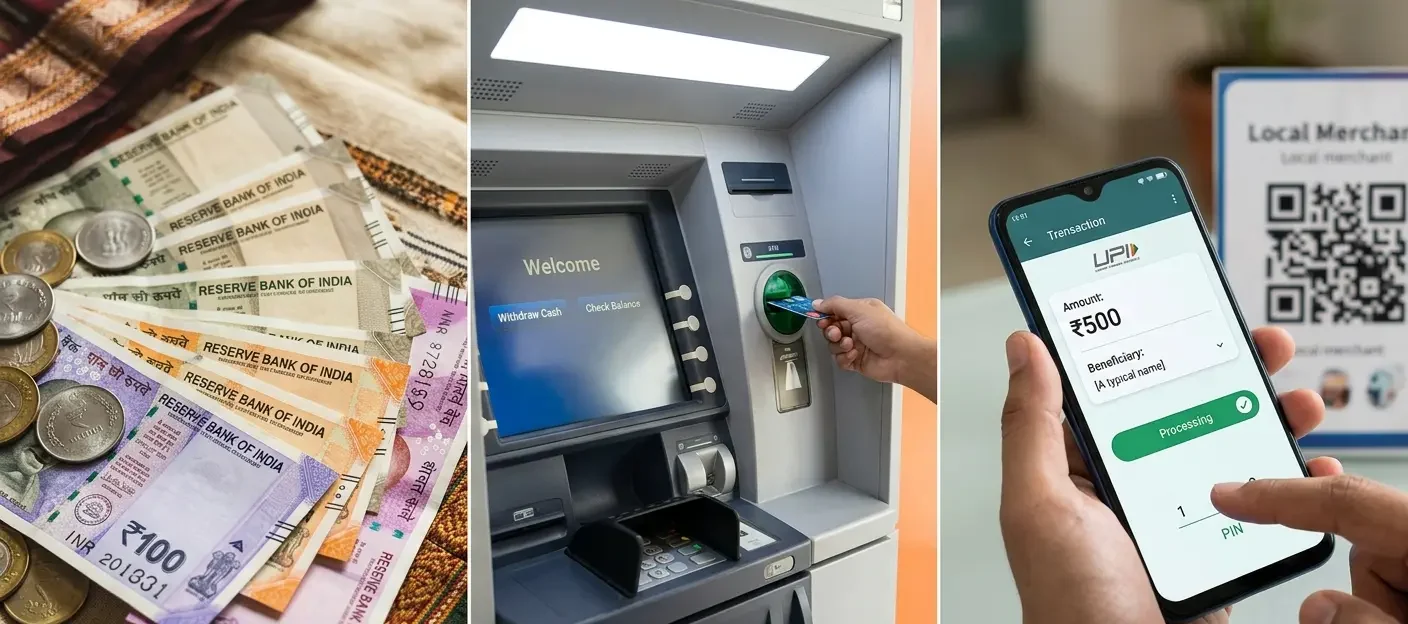
Money & Payment Options at a Glance
| Payment Option | How It Works |
|---|---|
| Cash | Indian rupees can be used for purchases and services where cash is accepted, particularly at smaller establishments. |
| Debit & Credit Cards | Cards are commonly accepted by larger businesses, hotels, restaurants and organised service providers, subject to card-network and merchant acceptance. |
| ATMs | ATMs allow travellers to withdraw Indian rupees using compatible cards, with fees and withdrawal limits varying by bank and card issuer. |
| UPI | UPI enables digital payments, commonly through QR codes, although access and eligibility can differ for international visitors. |
| UPI One World | An option for eligible international visitors to access UPI merchant payments without an Indian bank account, subject to current requirements and availability. |
| Currency Exchange | Foreign currency can be exchanged through authorised providers, with exchange rates, fees and supported currencies varying between providers. |
Visa & Entry Requirements for India
India generally requires foreign visitors to hold a valid visa or other permitted entry authorization before arrival. Eligible travellers can apply for an e-Visa online, while regular visas are available through Indian Missions or Posts for applicable cases. e-Visa categories include tourism, business, medical and other permitted purposes, with eligibility and conditions depending on nationality and visa type. Eligible applicants can generally apply at least four days before arrival, although applying earlier is advisable.
India also has a limited Visa-on-Arrival facility for nationals of Japan, South Korea and qualifying UAE nationals at designated airports, subject to specific conditions. Foreign nationals and OCI cardholders must also submit an e-Arrival Card within 72 hours before arrival, which is separate from a visa. Passport and supporting-document requirements can vary according to nationality and entry category. Always verify current requirements through India’s official visa and immigration authorities before travelling.
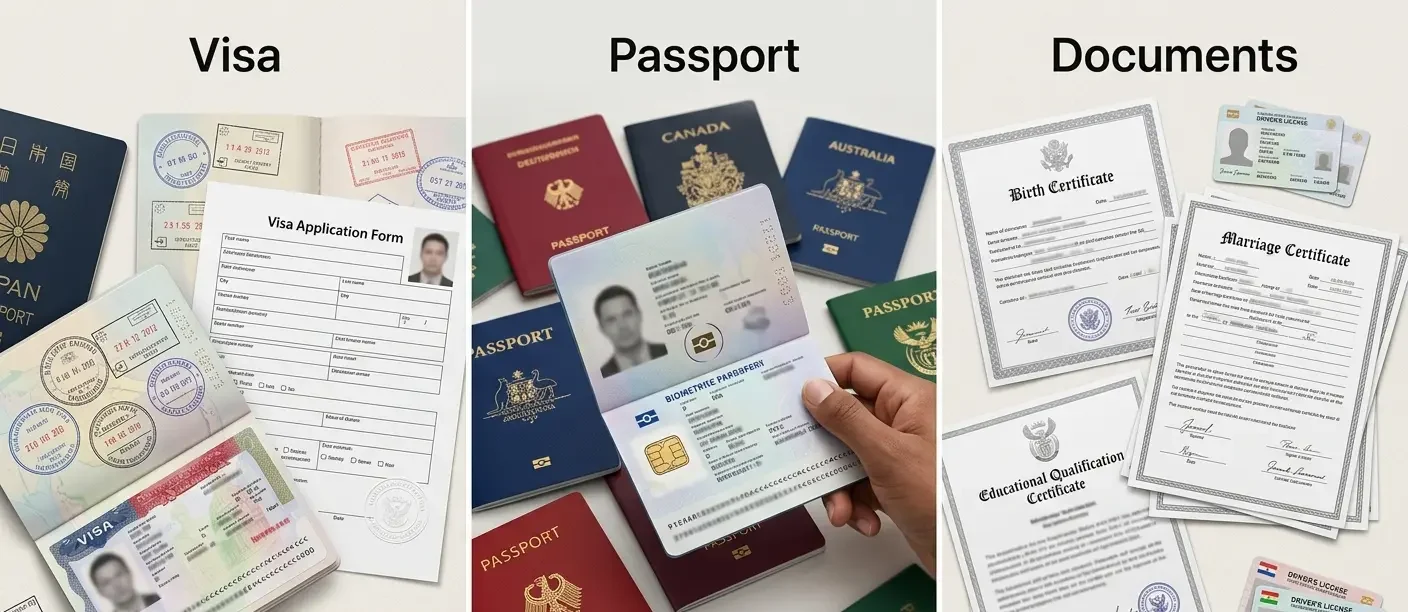
Visa & Entry Options at a Glance
| Entry Requirement | How It Works |
|---|---|
| e-Visa | Eligible travellers apply online before travelling and receive an Electronic Travel Authorization if approved. |
| Regular Visa | Applicable travellers apply through an Indian Mission or Post according to the relevant visa category and requirements. |
| Visa on Arrival | Available only to eligible Japanese, South Korean and qualifying UAE nationals at designated airports, subject to conditions. |
| e-Arrival Card | Foreign nationals and OCI cardholders submit arrival information online within 72 hours before arriving in India. |
| Passport & Documents | Travellers should carry the passport and supporting documents required for their particular visa or entry category. |
| Immigration | Entry involves immigration checks at an authorized entry point, where travel and visa documents may be verified. |